Resurgence in Natural Gas
The Gas Bridge: Firming Up a High-Demand Grid
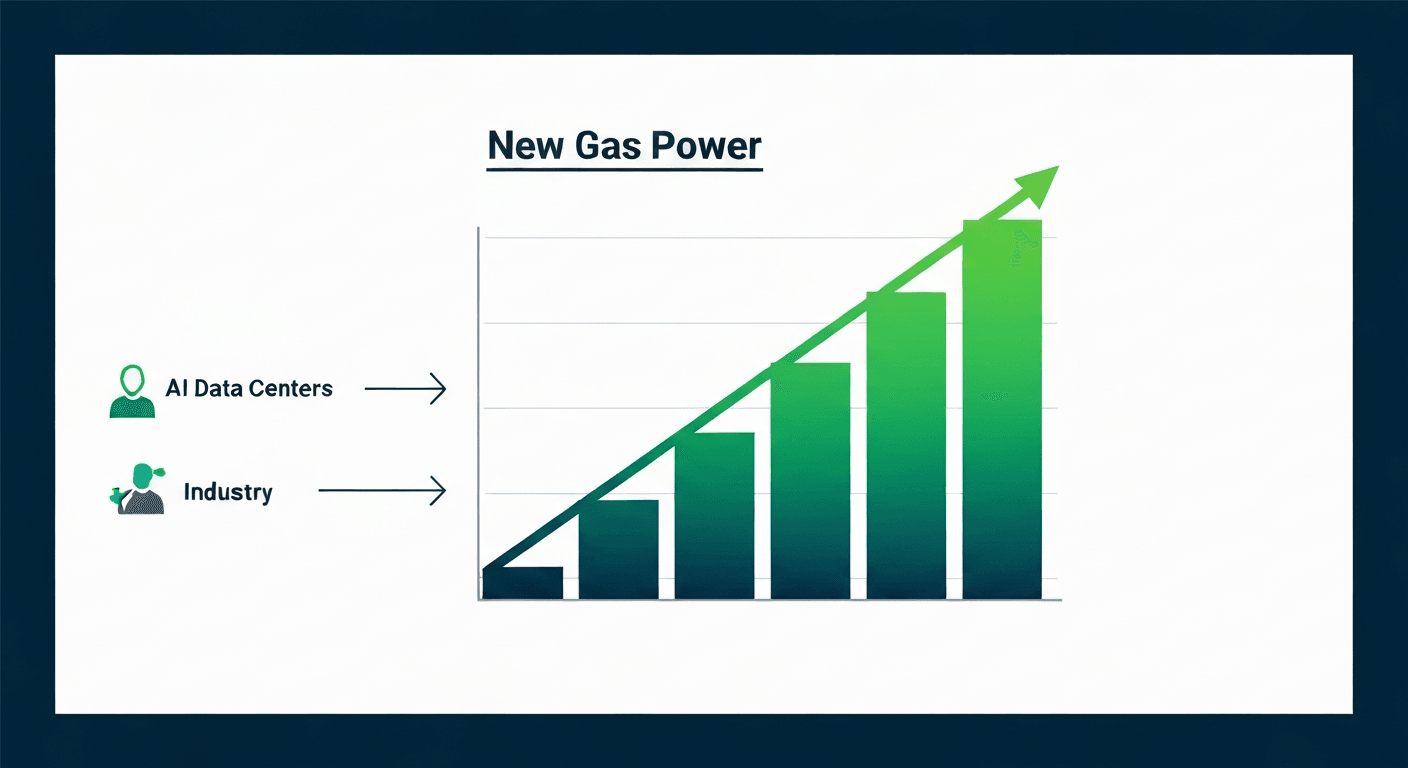
AI & Data Centers
Driving exponential load growth requiring 24/7 reliable power.
Electrification
Industrial and transport sectors add significant new baseload and variable demand.
Strained Grid
Facing unprecedented challenges to meet demand and ensure reliability.
This Week’s Response: A Surge in Planned Gas Generation
9 GW
RWE’s New U.S. Gas Pipeline
19.2 GW
U.S.-Japan Investment Framework
2 GW
Onsite Power for Data Centers
NH₃
Future-Proofing w/ Ammonia Co-firing
While the explosive growth in power demand from AI-driven data centers and broader electrification has dominated energy headlines for months, this week marked a pivotal shift from identifying the problem to deploying a specific, large-scale solution: a significant strategic resurgence of natural gas-fired generation. A cascade of major announcements from domestic and international players signals a pragmatic, industry-wide move to secure the dispatchable, firm capacity needed to support a rapidly changing grid. This renewed focus on natural gas generation isn’t just about meeting demand; it’s a direct response to the operational and financial realities of integrating vast renewable resources while ensuring grid stability.
The scale of this trend is staggering. European energy giant RWE, traditionally a leader in renewables, announced plans to add a massive 9 GW of flexible gas-fired power to its U.S. portfolio by 2031. This was followed by news of a landmark U.S.-Japan investment framework materializing into concrete projects, including a 9.2 GW plant in Ohio and up to 10 GW of hubs in Texas and Pennsylvania. These multi-gigawatt utility-scale projects are being complemented by a boom in behind-the-meter solutions. Nscale’s announcement that it will use Caterpillar natural gas engines to provide 2 GW of onsite power for a West Virginia data center campus tied to Microsoft and NVIDIA underscores a parallel trend where large load customers are bypassing grid interconnection queues to secure their own reliable power.
From a technoeconomic perspective, this pivot is driven by the need for speed, reliability, and cost-effectiveness. As the political and financial fallout from Georgia’s Vogtle nuclear plant illustrates, large-scale, carbon-free firm power projects face immense hurdles in cost and construction timelines. Natural gas plants, by contrast, offer a mature, scalable technology that can be deployed relatively quickly to bridge the capacity gap. Financially, the influx of international capital, particularly from Japan, provides a powerful tailwind for these capital-intensive projects. Technologically, these are not the inflexible peaker plants of the past; modern combined-cycle gas turbines (CCGT) and reciprocating engines offer the fast-ramping flexibility required to balance the intermittency of solar and wind.
This resurgence also comes with a nod toward future decarbonization. The successful demonstration of 100% ammonia combustion in F-Class gas turbines by IHI and GE Vernova provides a potential long-term pathway for these new assets. While immediate emissions are a concern, the strategic decision appears to be securing grid reliability now with assets that can potentially be retrofitted for low-carbon fuels like hydrogen and ammonia later. As FERC prepares a June decision on reforming grid interconnection rules for large loads, the industry is not waiting, signaling that for the foreseeable future, natural gas generation will be the critical backbone supporting both the energy transition and the digital economy.
This Week’s Top 5 Energy News Items
- RWE announces first U.S. gas generation projects with 9 GW in the pipeline
- U.S.-Japan investment framework takes shape around massive natural gas power projects
- FERC tees up June decision on data center interconnection reform
- Caterpillar engines to support 2 GW of onsite power at West Virginia data center campus tied to Microsoft, NVIDIA
- After 2 years, ratepayer pain and political fallout from Georgia’s nuclear plant Vogtle
For deeper technoeconomic analysis of your own energy projects, explore the CogenS platform.
Stay informed with insights from leading agencies like the U.S. Energy Information Administration (EIA) and regulatory bodies such as the Federal Energy Regulatory Commission (FERC).